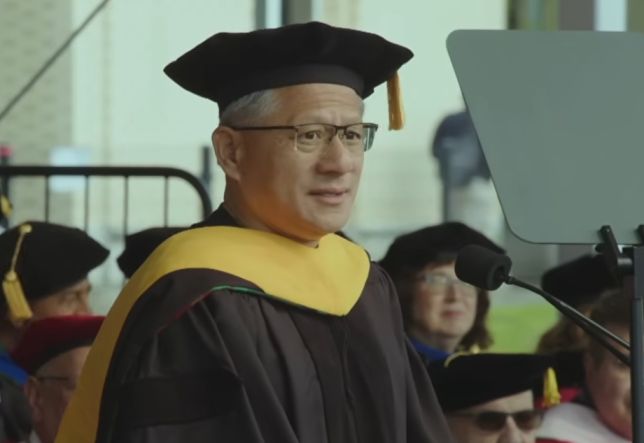
Editor’s Notes: In his 2026 Carnegie Mellon University commencement keynote, NVIDIA CEO Jensen Huang reflects on his personal journey from a first-generation immigrant to a leader in the tech industry. He explores the transformative power of the AI revolution, which he describes as a complete reset of computing that will empower individuals and reindustrialize America. Huang encourages the graduating class to embrace this new era with optimism and responsibility, urging them to put their hearts into their work as they shape the future. (May 11, 2026)
TRANSCRIPT:
JENSEN HUANG: President Jahanian, members of the Board of Trustees, faculty, distinguished guests, proud parents and families, and above all, the Carnegie Mellon class of 2026. Thank you for this extraordinary honor. It is deeply meaningful to be here with Carnegie Mellon, one of the world’s great universities, and one of the rare places that invents the future.
Today is a day of pride and joy. A dream come true for you, but not only for you. Your families, teachers, mentors, and friends help carry you here. Before we talk about the future, thank them. This day belongs to them too.
Graduates, please stand up. Stand with me. Come on, you guys. Especially, turn to your mothers and wish them a happy Mother’s Day. For you, this is another step in your life, but for her, this is a dream come true. Please sit down.
CMU students like robots take instructions one at a time. To see your graduate, to see you… Okay, everybody, focus. I have something important to tell you. To see you graduate from one of the world’s great institutions, this is her moment too.
The American Dream: Jensen Huang’s Immigrant Journey
My mom and dad are deeply proud of me as well. My journey is their journey. I am their dream come true. And their dream was the American dream.
Like many in this audience, I’m a first generation immigrant. My father had a dream to raise this family in America. When I was nine years old, he sent my older brother and me to the United States. We ended up at a Baptist boarding school in Oneida, Kentucky. Coal country. A town of a few hundred people.
Two years later, my parents left everything behind to join us. They came with little to nothing. My father was a chemical engineer. My mother worked as a maid at a Catholic school. She woke me up at 4 a.m. in the morning to deliver newspapers. My older brother got me a job as a dishwasher at Denny’s. Which, at the time, felt like a major career advancement.
That was my view of America. Not easy, but full of opportunities. Not a guarantee, but a chance. My parents came here because they believed America could give their children a chance. How can we not be romantic about America?
Meeting Lori and the Early Days of Family Life
I went to Oregon State University. I met my wife, Lori, when I was 17 years old. I was the youngest kid in school. We were sophomore lab partners. She was 19. An older woman. I beat out 250 other boys in class and won her heart. We’ve now been married for 40 years. We have two amazing children, both working at NVIDIA.
Founding NVIDIA: Humility, Honesty, and Survival
When I was 30, I started NVIDIA with Chris Malachowsky and Curtis Priem, two amazing computer scientists. We wanted to build a new kind of computer, one that could solve problems ordinary computers could not. We had absolutely no idea how to build a company, raise money, or run NVIDIA. I just thought, how hard could it be? It turns out, it isn’t super hard.
Our first technology didn’t even work. We nearly ran out of money. At one point, I had to fly to Japan and explain to Sega’s CEO that the technology they contracted us to build would not work. Asked to be released from a contract we could not complete. And then asked that they still pay us. Without the money, NVIDIA would vaporize.
It was embarrassing, humiliating, and one of the hardest things I have ever done. And Sega’s CEO, Irimaji-san, said yes. I learned early that being CEO is not about power, but the responsibility that comes with keeping the company alive. And that honesty and humility can be met with generosity and kindness, even in business.
We used the money to reset the company, and out of desperation, we invented new ways of designing chips and computers that we still use today.
For 33 years, NVIDIA had reinvented itself over and over again, each time asking, how hard can it be? And each time learning, it’s harder than we thought. But through those experiences, we learned never to see failure as the opposite of success. Each failure is just another learning moment, a humility moment, a character-strengthening moment. The resilience forged through setbacks is what gives you the strength to go again.
Today, I am one of the longest-serving CEOs in technology. Enjoy the full version. NVIDIA, the body of work I share with 45,000 extraordinary colleagues is my life’s work. Now it’s your time to realize your dreams. And the timing could not be more perfect.
The AI Revolution Begins Here
My career started at the beginning of the PC revolution. Your career starts at the beginning of the AI revolution. I cannot imagine a more exciting time to work, to begin your life’s work.
AI started right here at Carnegie Mellon. Woo! Woo! Woo! Woo! Woo! Woo! Woo! Woo! Woo! Woo! Woo! Woo! That’s my first year at Carnegie Mellon.
Carnegie Mellon is one of the true birthplaces of artificial intelligence and robotics. In the 1950s, researchers here created the Logic Theorist, widely recognized and considered the first AI computer program. In 1979, Carnegie Mellon founded the Robotics Institute. This morning I visited with Robo Club, the first academic institute devoted entirely to robotics.
A Complete Reset of Computing
Artificial intelligence has gone on now to reinvent computing completely. I have lived through every major computing platform shift.
Mainframes, PCs, the internet, mobile, and cloud. Each wave built on the one before. Each expanded access, each transformed industries and society, but what is about to happen now is bigger than anything before.
Computing is undergoing a complete reset. Not since modern computing was first invented. For 60 years, computing worked the same way. Humans wrote software, computers executed instructions. That paradigm is over.
Artificial intelligence has reinvented computing. From human coding to machine learning. From software running on CPUs to neural networks running on GPUs. And from following instructions to understanding, reasoning, planning, and using tools. A new industry has emerged. To manufacture intelligence at scale. Because intelligence is foundational to every industry, every industry will change.
Advancing AI Wisely and Responsibly
For many, AI creates uncertainty. People see AI writing software, generating images, driving cars. And naturally wonder what happens next. Will jobs disappear? Will people be left behind? Will this technology become too powerful? Every major technological revolution in history created fear alongside opportunity. When society engages technology openly, responsibly, and optimistically, we expand human potential. Far more than we diminish it.
So first and above all, we must be clear that artificial intelligence, the automation of understanding, reasoning, and problem solving, is one of the most powerful technologies humanity has ever created. And like every transformative technology before it, it will bring both great promise and real risk. The responsibility of our generation is not only to advance AI, but to advance it wisely.
Scientists and engineers have a profound responsibility to advance AI capabilities and AI safety together. Policymakers have a responsibility to create thoughtful guardrails that protect society while still allowing innovation, discovery, and progress to move forward.
History shows that societies that retreat from technology do not stop progress. They only surrender the opportunity to shape it and to benefit from it. So the answer is not to fear the future. The answer is to guide it wisely, build it responsibly, and ensure that its benefits reach as many people as possible. We should not teach fear of the future. We should engage it with optimism, responsibility, and ambition.
Everyone Is Now a Programmer
Only a fraction of the people in the world know how to write software. Now, anyone can ask AI to build something useful. A shopkeeper can create a website and grow a business. A carpenter can design a kitchen and offer new services to clients. The AI writes the code. Everyone is now a programmer. For the first time, the power of computing and intelligence can truly reach everyone and close the technology divide. The first time.
AI and the New Industrial Era
And like electricity and the internet before it, AI will require trillions of dollars of infrastructure investment. This is the largest technology infrastructure build out in human history. And a once in a generation opportunity to reindustrialize America and restore the nation’s capacity to build.
To support AI, America will build chip factories, computer factories, data centers, and advanced manufacturing facilities across the country. AI gives America the opportunity to build again. Electricians, plumbers, iron workers, technicians, builders, this is your time. AI is not just creating a new computing industry, it is creating a new industrial era.
Powering this new infrastructure will require enormous amounts of energy. But it is also driving one of the largest investments in energy infrastructure in generations. Modernizing the grid, expanding power generation, and accelerating sustainable energy.
AI Will Change Every Job — But Not Replace Human Purpose
And yes, AI will change every job. But the task and the purpose of a job are not the same. Many tasks will be automated. Some jobs will disappear. But many new jobs and entire new industries will be created.
Software coding tasks are increasingly automated. But using AI, software engineers can expand the search for solutions, allowing them to tackle far more ambitious challenges. Analyzing radiology scans is increasingly automated. But using AI, radiologists are elevated to better diagnose disease and care for patients.
AI does not replace human purpose. It amplifies human capability. That is why, even as AI writes more code and analyzes more scans, demand for software engineers and radiologists continue to grow.
AI is not likely to replace you. But someone using AI better than you might. So a good thought experiment is this. Do we want our children to be supercharged by AI? Or be left behind by those who are? No parent wants their child left behind.
Build AI Safely and Inclusively
So let us build AI safely. Let us also imagine an optimistic future. One our children are excited to be part of, inspired to help build. So we can and must do four things at once. Advance safely. Create thoughtful policies. Make AI broadly accessible. And encourage everyone to engage. Everyone should have AI. Opportunities should not belong only to the people who can code.
A Message to the Class of 2026
Class of 2026, you are entering the world at an extraordinary moment. A new industry is being born. A new era of science and discovery is beginning. AI will accelerate the expansion of human knowledge and help solve problems once beyond our reach.
We have the opportunity to close the technology divide and bring the power of computing and intelligence to billions of people for the very first time. To re-industrialize America and restore our capacity to build. And to help create a future more abundant, more capable, and more hopeful than the world you inherited.
No generation has entered the world with more powerful tools or greater opportunities than you. We are all standing at the same starting line. This is your moment to help shape what comes next. So run, don’t walk.
Carnegie Mellon has a motto I love. “My heart is in the work.” So put your heart in the work. Build something worthy of your education, your potential, and the people who believed in you long before the world did.
Congratulations, Carnegie Mellon, class of 2026. Thank you. Congratulations to everyone. Thank you. Congratulations. Congratulations. Thank you.
Related Posts